Friday, 7 December 2012

Two More Thumbnail Sketches


After my previous post yesterday, I decided to tackle two more thumbnail sketches on my iPad using the same technique. The one above is drawn from memory and imagination, just as the second one is below. Although tomorrow looks like being a nice bright day, if not a little cold. If so, I shall take a drive out and have a go at painting some more thumbnails from observation. That's the real test. Working directly from nature can often be daunting. Finding a good subject can be even more so.


Thursday, 6 December 2012

Two Thumbnail Sketches


What I particularly like about painting on my iPad is the speed with which I can work. For making visual notes such as this one, and the one below it is ideal. For these two thumbnail sketches, which I did from memory I used the pencil and the technical pen on ArtRage. Although I like to add a little texture with the roller, or block in the colours very quickly with the paint pot, the technical pen can be applied over the whole drawing in bright transparent colours without having to go around the drawing itself. On a separate layer above the original however, it would mask what is underneath. The opacity of the colour of course, determining how translucent, or opaque the colour is.


Friday, 23 November 2012

The Psychological Makeup of an Image


As with any painting, whether it be a figurative one such as this, or one that is purely abstract there is an intense psychology at work. After I painted the head and shoulders of this young teenage girl I was so taken by how I had managed to capture the look of complete vacancy on he face, and the rather despondent way her head hung forward and down, I had to see how I would tackle the rest of her. To enlarge the composition on iPad is quite easy. You post the original to your photos then post it back onto another sheet of paper in your app, which in this case is ArtRage. You can then manipulate the original drawing to whatever size you want, within the picture plane. Here for example, is the original.


Next, the same image positioned onto a new sheet of paper.


From here it is just a matter of continuing the drawing. Although if you add another layer you can erase whatever you add to the picture without erasing the original, which makes mopping up any mistakes so much easier. Now, I don't know if you would agree with me but once I had completed the image it seemed to me that the empty space on the left added to the sense of isolation the girl in the picture appeared to be feeling. If indeed, that is what she is feeling. Although there is a way of testing this, and that is by adding another figure to see if it helps or hinders. However, to do this I first had to save the image then copy it, without posting it again to my photos.

The next image; half drawn, shows a young man wearing sunglasses. I had drawn in his eyes originally, but couldn't quite get the look on his face that I wanted. He began to look incongruous... Baring no relationship whatsoever to the girl. So I gave him a pair of very dark sunglasses to hide his feelings towards her: which is a cop out I admit, but by then I was beginning to realise I should have gone with my initial thoughts on the matter. Adding another person somehow trivialises the image, and turns it into a joke. I can almost hear him say, "So what do you make of my new shades?"


 Then again, maybe he is just a badly drawn boy. Maybe if I had made the effort I could have added something more: to provide some sort of message. To make something of a statement about human relationships for instance. It is difficult to say for sure, and why I always go with my gut feelings when it comes down to the psychology of picture making. The more uncertain your feelings are towards the girl; from an artistic point of view at least, the better. Why spell everything out?

Thursday, 22 November 2012

Landscape Painting on iPad


This image was painted from memory of my time in Cumbria, the English lake district. The mountain range in this region was carved away during the last ice age. So the valleys have quite steep slopes and cliffs either side owing to the action of glaciers. Although the fells are not all that high they are very rugged, and covered for the large part in trees. In fact from the road the trees tend to block your view as you can see.

By contrast the place where I live in Lancashire is very flat. On the boundary of Chat moss: an ancient peat bog that was drained much later for farming purposes. In fact I live by the biggest drain of all, the Manchester Ship canal that runs from Liverpool to Manchester. However, there are not any high vantage points to view the moss from so the image below is a bird's eye view which I did entirely from imagination. The mountain in the distance on the far right is known as Winter Hill.


On the other hand, this tiny enclave is a part of Chat moss that is easy to miss from the road, and leads directly to the farms. As you can see it is painted in a more realistic fashion taken from a photograph.


Moving westward into Wales the next image is of the Vale of Llangollen painted again from memory and imagination.


Again, the following is my impression a typical Welsh valley that I did in the context of a thumbnail sketch, hence the rather rapid strokes which I prefer because they activate the surface and animate the composition more.


In a more fanciful fashion this next one could be almost anywhere in the world, but reminds me again of being on the slopes of the Lakeland fells. Except that the colours make it look rather more exotic.


Overlooking the Mersey estuary is the lovely village of Frodsham. This is painted from memory of the escarpment above the village, which I did in watercolour on my iPad.


Another watercolour, of a field with trees, which again, could be the backdrop to any rural setting.


In the next image I got a little carried away with creating a textured surface to evoke the sense of a mid, to late twentieth century modernist style of painting. To be honest with you I love this way of working because it is so much more adventurous.


In fact, here again in the following two images I expand on this modernist approach to produce something equally exotic and stimulating on the eye. Albeit, a little less frenetic in character.


I shall finish with two more images that were intended for illustration purposes only. One is of a grave yard overlooking a valley in autumn just as the leaves are falling, and the second of the Grand Canyon in America which I have never visited, but have always wanted to. Although because of the bright primary colours it does tend to look like a backdrop to a Walt Disney cartoon.


Figure Painting on iPad


What I particularly love about painting on my iPad is that when it comes to painting the human figure from memory and imagination I can work with such speed, and am able to erase my mistakes so easily. The layering process on my app, ArtRage, also makes it possible to create irregular patterns of such complexity they can bring a simple drawing to life in an instant. This image of a rather awkward looking teenager came about entirely by accident. I tend to throw down a few simple lines in pencil with a vague idea of a figure in mind, then try to visualise what that person might be doing. If I cannot see anything of interest I erase and start again. This happens on a regular basis and why, with iPad I don't need to have any concern about the amount of paper I am going through. However, because I can create such variation on this devise I am prone to change my approach with each image, and can so easily loose any sense of consistency. Here are two more examples to show you what I mean.


I did all three of these last night, and as you can see they have absolutely nothing in common; subject wise at least, though the background is familiar. I have to admit I do get bored with repeating myself. Although I am slowly developing a formula, and maybe in time will find what I am looking for. Until then I shall continue to entertain you with my thoughts and images.

Tuesday, 20 November 2012

Figure Painting on iPad


I love painting the human figure from memory because it really tests your skill and knowledge of anatomy to the limit. I don't begin with anyone in particular in mind, or vision of how they will appear when I have finished. I just start drawing and then add colour. Sometimes I begin with a quick outline in pencil, or in silhouette. Such as if I am wanting to capture the figure(s) in a certain pose. Here are three examples of what I mean...


And so on... Although they finish up more as characterizations than of real figures for this reason. To my eye at least, they appear more animated and alive. Unless that is, I am copying a figure from a photograph, or from direct observation. If not, then I avoid trying to be too precise for fear of overworking the painting. The image below is one exception, in which I was trying to capture a figure of a young dancer in a typical Degas like fashion: posing with her head held back and eyes closed as if resting, or contemplating her previous movements. In this case therefore, I wanted her to be as life like as I could make her, which was difficult but not impossible.


Monday, 19 November 2012

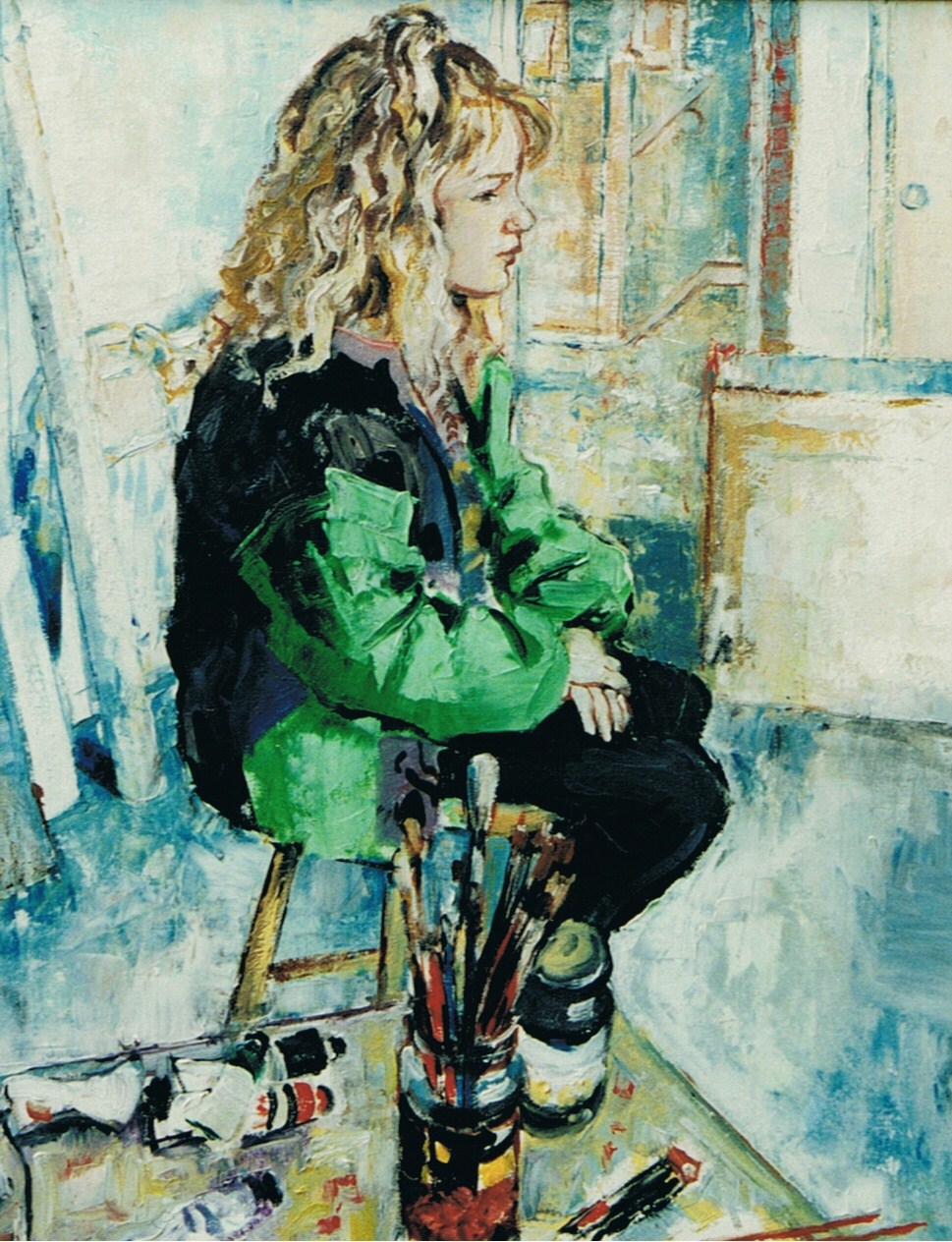
Portrait of Lucy. Oils (1992)


Lucy is the daughter of a neighbour of mine. Although she was only about nine, or possibly ten years old when I painted this she is taller than me now. I was taken with her very pretty eyes and long blond locks held back with a small ribbon. I just had to paint her, and asked her to sit for me.

Because my studio is rather small, my intention was to execute the painting looking through a large mirror I had on the wall. To give me more space to position my easel without blocking my view of her. However, I soon realised this was not going to be as easy as I had imagined. As I turned towards the mirror I discovered there was nowhere to plant my large studio easel without it getting in the way. It was then that I turned to face Lucy and discovered she has positioned herself on the tall wooden stool looking directly out of the window at the view. It was perfect. "Stay just like that Lucy," I said, "and stay perfectly still." In fact she did. She never flinched a muscle and in about three hours I had completed it... with a short break in between of course.